



About URO
When PSU’s earlier predecessor, the Palawan Teacher’s College (PTC), was enacted in 1965 through Republic Act (RA) 4303 and started operating in 1972, one of the main offices established the Research Unit (RU). Such RU was created to develop an integrated program of educational research. Its functions were to cooperate and coordinate the efforts of the faculty members and academic department in structuring and carrying out research projects that led to the conduct of several studies about the course offerings of PTC the college. Among the major accomplishments are the Faculty Code, Student Code, and Student Handbook. The RU was transformed into the current University Research Office (URO).
URO’s Mandates and Activities
At present, the URO is the frontline units of PSU for its research programs and activities. It coordinates and facilitates the implementation of all research-related tasks of the university. It spurs the involvement of PSU’s faculty and staff members who are engaged in various research projects, activities, technical support and managerial tasks.
The URO regularly conducts a series of training-workshops to enhance and strengthen the skills and knowledge of faculty and staff who handle and manage research studies and projects. In addition, the URO provides funding opportunities for research studies, and research publication and dissemination.
Current and Upcoming Projects
The URO is currently involved in the following research projects: Capacity Building, Collection, Isolation, and Identification of Microalgae - Diversity of Microalgae in Selected Areas of Luzon (with state partner); Responding to Fish Extirpations in the Global Marine Biodiversity Epicenter (with state partner); Supply and Quality of Potable Water and Prevalence of Water-Borne Diseases In Selected Community-Based Eco-Tourism Sites in Puerto Princesa City (with state partner); Intrapartum and Essential Newborn Care in MIMAROPA (with state partner); and Enhancing the Production and Postharvest Handling of Cashew in Improving the Quality of Product (with state partner).
Some of its upcoming projects are: Greening the Resorts: Design and Development of a Low Cost Solar Water Heater (with state partner); Cataloging of Small-Scale Fishing Gears for Future Sustainable Coastal Resource Management Endeavors (with state partner); Baseline Study on Traffic Noise of Selected Roads in Urban Areas of Puerto Princesa City; Coastal Erosion Assessment and Mapping of Sitio Sabang, Barangay Cabayugan, Puerto Princesa City (with state partner); and Development of Low Cost Autonomous Optical Sensor for Early Detection of Algal Blooms (with state partner).
Linkages and Partnerships
Since its establishment, the URO has engaged in various collaborations with research funding agencies, government units and universities, locally and abroad. Partnerships with the following:
- Commission on Higher Education (CHED) ched.gov.ph
- Conservation International (CI), Conservation International
- Philippine Council for Health Research and Development Consortium (PCHRD), (dost.gov.ph)
- Swedish Environmental Institute (SEI), (sei.org)
- University of the Philippines Diliman (upd.edu.ph) have spurred research outputs that facilitate development in Palawan’s local communities, contributed to policy-making processes and added to PSU’s body of knowledge.
Contact details
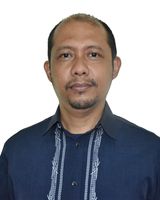
Prof. Michael Angelo Doblado
OIC University Research Director
University Research Building, Palawan State University,
Tiniguiban Heights, Puerto Princesa City
E-mail: uro@psu.palawan.edu.ph
psuresearch.wordpress.com
FB page: Palawan State University Research Office
BIO NOTE
Prof. Michael Angelo A. Doblado holds a Bachelor of Arts in Social Sciences (Political Science-History) from the University of the Philippines-Baguio City and a Master’s in Public
Administration from Palawan State University. He is currently pursuing a Master of Arts in Education (Social Sciences) at PSU. As a licensed teacher, Prof. Doblado has served as a
national trainer for the Department of Education’s K to 12 curriculum in Araling Panlipunan for Grades 7, 8, and 10, and as a regional trainer for the Commission on Higher Education’s new General Education Curriculum.
His research interests focus on local history, heritage, and Palawan studies. He has presented papers at various international conferences sponsored by the Philippine Historical Association and has co-authored articles in both national and international journals.
Prof. Doblado's landmark research, “The Palawan Landfall of the Magellan-Elcano Voyage,” was submitted as an official position paper to the National Historical Commission of the Philippines (NHCP) in November 2019. This research identified the approximate locations of the Magellan-Elcano expedition’s landings in Palawan and served as the basis for the Philippine government to install historical markers in Aborlan, Brooke’s Point, Bataraza, and Balabac, officially recognizing these sites as part of the First Circumnavigation of the World.
A former Chairman of the Social Sciences Department and Director of the University Intellectual Property Office, Prof. Doblado currently serves as the Director of the Palawan Studies Center and the Officer-in-Charge Director of the University Research Office.
Research Vision, Mission
Research Vision
Sustainable and resilient communities in the Asia Pacific region through Research, Development, and Innovation.
Research Mission
The Palawan State University shall pursue research, development, and innovation programs that promote sustainable development and resilience through inclusive economic growth, research and development utilization, and environmental and cultural integrity.
Research Goals, Objectives and Agenda
Goals
One of the leading universities in the Asia Pacific enhancing community resilience and sustainable development in the Philippines through research, development, and innovation.
Objectives
By 2028, Palawan State University targets to achieve the following objectives aligned to the University Research, Development, and Innovation (RDI) Agenda to foster a dynamic research environment that advances knowledge, addresses pressing societal challenges, and promotes inclusive growth in the fields of Agriculture, Aquatic, and Natural Resources, Health Research and Development, Industry, Energy, and Emerging Technology, Disaster Risk Reduction and Climate Change, and Sustainable Communities:
UNIVERSITY RESEARCH, DEVELOPMENT & INNOVATION AGENDA 2023-2028
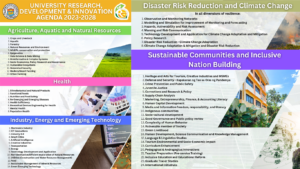
Agriculture, Aquatic, and Natural Resources (AANR):
- Sustainable Farming Practices: Develop and promote sustainable farming methods that increase crop yields while reducing environmental impact, with a particular focus on organic farming, soil health, precision agriculture, agroecological practices, production, and marketing.
- Aquaculture Innovation: Advance aquaculture research to increase the efficiency and sustainability of fish and seafood production and catchment, including breeding programs for disease-resistant species and the development of low-impact aquaculture systems.
- Natural Resource Management: Develop strategies for the sustainable management of natural resources, including forests, fisheries, and water resources, particularly those situated or affected by mining activities, and tourism. Also, to
strengthen the key biodiversity area baseline studies. - Climate Change Adaptation and Mitigation: Progress monitoring carbon sinks and groundwater, and intensify climate change countermeasures such as household permaculture, and crop resiliency.
- Water Resource Conservation: Formulate comprehensive watershed map and profiling in Palawan; vulnerability studies particularly due to human settlements and microplastic pollution; and to strengthen hydrological studies.
- Socioeconomic, Policy Research and Governance: Integration of social concerns in fishery, forestry, and natural resource utilization, supply, and production; strengthening communication of research results to stakeholders, and capacity building, and further studies of the AANR-related policies.
Health Research and Development
- Ethnobotanical and Natural Products: Documentation of traditional knowledge of Indigenous and local communities regarding plants and natural resources for food, and medicine; phytochemical analysis and ecological studies of plants for
drug discovery and product development. - Functional foods, and Health Sufficiency: Provide an avenue to study the economic opportunities of natural resources (raw material) for the community; standardization of sold food including its health implications; steady market for local producers; and documentation of local medicinal plants
- Re-emerging and Emerging Diseases: Strengthening health research on a wide array of diseases through surveillance and early detection, understanding pathogens, transmission dynamics, vaccines and therapeutics, public health
preparedness, and risk communication and education. - Mental Health: Recognizing mental health by understanding, preventing, and addressing mental health disorders through prevalence and epidemiology; risk factors and protective factors; early intervention and prevention; mental health stigma; treatment efficacy; mental health services; mental health and physical health correlations; cultural and societal influences; suicide prevention; mental health in the workplace; and digital mental health.
Industry, Energy, and Emerging Technology
- Electronics Industry: Assess emerging trends and disruptive technologies; analyze environmental impact of electronic wastes; explore supply chain resilience.
- ICT Innovations: Explore the impact of artificial intelligence (AI) and machine learning on various industries; investigate the IoT (Internet of Things) security and privacy challenges and propose solutions to protect data and systems.
- Industry 4.0: Examine the adoption and integration of Industry 4.0 technologies in manufacturing processes, evaluate the skills gap in the workforce due to digital transformation and develop strategies for upskilling and retaining the labor force.
- Smart Cities: Develop land use strategies, particularly through zoning laws in the city and every municipality; integration of GIS in land-use planning; as well as a creation of database for the arrival of tourism and prediction of its influx in the province
- Creative Industries: Promotion of local heritage in the area by strengthening the unrecognized local culture in the community.
- Transportation: Attention to traffic density and carrying capacity of roads in the City, with the integration of optimum route and passenger safety; strategies for the tourist route with difficult access
- Energy: Promotion of sustainable energy and addressing issues of alternative energy sources, especially in GIDAs (Geographically Isolated and Disadvantaged Areas)
- Sustainable Management of Mineral Resources: Develop and implement strategies, policies, and practices that ensure responsible and environmentally sound mineral resource extraction, utilization, and conservation while being economically viable and socially acceptable.
Disaster Risk Reduction and Climate Change
- Detection, Monitoring, and Forecasting: Provide basis and develop strategies or technologies to standardize detection, monitoring, and forecasting of natural calamities, hazards, and other vulnerabilities (e.g. heavy rainfall, landslides); and to generate accurate warnings in a timely fashion that allow sufficient time for the affected communities to enact their disaster management plans appropriate for the present hazard.
- Climate Change Adaptation, and Policy Research: Provide basis in the formulation of climate change policies and strategies mainly in the reduction of emissions from various sources, with the integration of the health and economic impact of climate change to marginalized vulnerable stakeholders from the
Sustainable Communities and Inclusive Nation Building
- Heritage and Arts Tourism and Creative Industries: Promotion of Palawan’s Indigenous knowledge, culture, and heritage for the enrichment of the city and the province’s creative industries
- Tourism Environmental and Socioeconomic Impact: Integration of ecological and socioeconomic impact to promote sustainable tourism in the province
- Public safety, correction, and policy research: Addressing and improving the criminal justice system and well-being of society through assessment of community policy initiatives and practices, crime reduction, and law enforcement
- Human Capital Development, Market, and Supply Chain: Adapt to changing business landscapes, improve human capital development, enhance market competitiveness, and optimize supply chain operations
- Vulnerable members of society, human behavior, governance, and MIL: Study vulnerable populations, and the effectiveness of social services; investigate psychological factors influencing decision-making and incentives affecting human behavior, and investigate the role of transparency and accountability in government and public institutions; examine patterns of media consumption particularly on misinformation and disparities in access to information and digital resources
- Inclusive education and educational reform: Research in inclusive education and educational reforms ensuring all students have equal access to quality and educational opportunities.
Research Areas/Priority Areas
I. Crops
- Feasibility Studies of Cashew nut year-round production.
- Feasibility of commercializing Indigenous Rice: Coron’s “Camorose”
- Impact utilization of forest products and other crops
- Impact assessment on existing monoculture farming practices
- Packaging and disseminating successful agricultural practices
II. Livestock
- Evaluation of Palawan Inter-municipality livestock supply chains
III. Aquatic
- Feasibility study of Kuracha’ (aquatic food) in Araceli, Palawan
- Damage Assessment of Palawan’s Seaweed’s production (Typhoon Odette )
- Impact assessment of Seaweeds Ice-Ice disease (Where?)
VI. Climate Change Adaptation and Mitigation and Disaster Risk Reduction
- Monitoring groundwater data and carbon sinks of selected critical areas in Palawan
- Household Permaculture and climate change mitigation
- Vulnerabilities and Threats to Palawan’s seasonal crops
VII. Socioeconomics, Policy Research and Governance
- Studies on Financial literacy and Farmer empowerment.
- Changing Labor Demands its Effect on Fish Production Fishermen
- Studies of Local Land Conversion and effect on food production and supply.
- Bridging the Knowledge Gap between the Academe and Local Community.
- Gap between academe and local government units or community in communicating research results
- Assessment of local Policies addressing environmental vulnerability
- Palawan Indigenous fruits and other local products: Supply Chain studies
URO Downloadable Forms
- Activity Evaluation Sheet 2023
- Application for Support to Research Presentation
- Checklist for Publication Incentive_revised 2023
- College-Cluster Monitoring and Accomplishment Report - revised 2023
- Detailed Research Proposal
- Request (for document) Form
- Research Publication Incentive Clearance Form
- Revised Quarterly Progress Report
- Terminal Report
Research Coordinators and Directory
| CAH | Aileen Joy Pactao | apactao@psu.palawan.edu.ph |
| CBA | Mary Grace A. Masdo | mgmasdo@psu.palawan.edu.ph |
| CCJE | Rexel Mae Reyes | rmreyes@psu.palawan.edu.ph |
| CEAT | Ana Jessica Morales | ajmorales@psu.palawan.edu.ph |
| CHMT | Zharifa Flevie Carim | zfcarim@psu.palawan.edu.ph |
| CNHS | Jairus Katon | jkaton@psu.palawan.edu.ph |
| CS | Geronimo Allan Jerome G. Acosta | gacosta@psu.palawan.edu.ph |
| CTE | Vincent Esguerra | vesguerra@psu.palawan.edu.ph |
| GS | Mc Arthur Maravilla | mamaravilla@psu.palawan.edu.ph |
| SOM | Ruth Anne Abis-Gemarino | ragemarino@psu.palawan.edu.ph |
| 1 Oriental (Roxas, San Vicente, Dumaran, Araceli) | Roderic Derecho | rderecho@psu.palawan.edu.ph |
| 2 Del Norte - (El Nido, Taytay, Linapacan, Coron) | Maria Fe S. Roque | mfroque@psu.palawan.edu.ph |
| 3 Occidental (Narra, Quezon, Rizal) | Gerlie Boni | gboni@psu.palawan.edu.ph |
| 4 Del Sur (Bataraza, Sofronio Española, Brooke's Point, Balabac) | Jerone Avel S. Cansino | jacansino@psu.palawan.edu.ph |
| 5 PCAT Cuyo | Agnes A. Factor | afactor@psu.palawan.edu.ph |
| San Rafael | Mark Jude L. Opinaldo | 2018100011bp@psu.palawan.edu.ph |
| ETEEAP | Ma. Ching A. Sayang |
University Research Office
| Michael Angelo A. Doblado | madoblado@psu.palawan.edu.ph |
| Mishel Angielic G. Castro | macastro@psu.palawan.edu.ph |
| Alexes Mae C. Diaz | adiaz@psu.palawan.edu.ph |
| Marilyn M. Arenio | marenio@psu.palawan.edu.ph |
| Dariel P. Macmac | dmacmac@psu.palawan.edu.ph |
| Leony Rose P. Magbanua | lrmagbanua@psu.palawan.edu.ph |
Ground Floor Student Innovation Park Building,
Palawan State University, Tiniguiban
uro@psu.palawan.edu.ph
psuresearch.wordpress.com